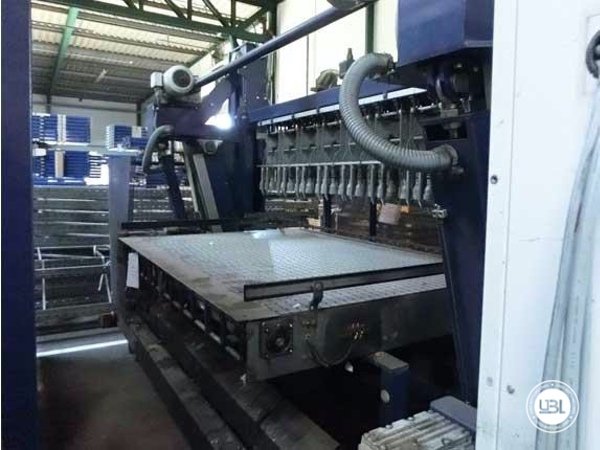
Technical Specifications & Performance Data The KETTNER Blitzpac A40
T1 is a robust decrater engineered for returnable bottle handling
within a used bottling line. It reliably removes bottles from crates
and feeds them toward rinsing, filling, capping, and labeling
stations, making it ideal for beverage production and broader
industrial packaging workflows. Manufacturer: KETTNER Model: Blitzpac
A40 T1 Year: 2002 No. of heads: 1 Control system: Siemens S7 PLC
Electrical: 400V, 50Hz Capacity: 350 Tk/h (as per documentation) Max
pulse length: 2,100 mm Bottle table width: 2,170 mm Container track
height: 750 mm Bottle table height: 1,200 mm Container types:
Returnable glass as primary; potential for PET depending on installed
tooling and format parts Typical applications: Water, juice, beer,
wine, and soft drinks in returnable systems Advanced Automation &
Control Systems Featuring a Siemens S7 PLC, this decrater offers
dependable automation with clear diagnostics and stable operation. The
control architecture supports integration with upstream crate
conveyors and downstream bottle conveyors, synchronizing
infeed/outfeed to maintain smooth line balance. Electrical
configuration is 400V, 50Hz, matching standard European industrial
power supplies. Safety features are included and designed to protect
operators and maintenance personnel. These typically include
interlocked guards and emergency stops positioned for quick access,
contributing to reliable, repeatable bottle extraction and minimal
downtime. Original manuals are available to support commissioning,
operation, and maintenance. Production Line Integration Capabilities
The Blitzpac A40 T1 is engineered to interface seamlessly with
returnable line components such as crate conveyors, bottle rinsers,
fillers, cappers, and labelers. It can be deployed before rinsing and
filling on a used bottling line and coordinated with case packing or
repacking systems after labeling. Format changes are carried out
through tooling and recipe parameters in the PLC where applicable,
enabling flexibility for different bottle heights and diameters within
the machine’s mechanical range. Whether the line is dedicated to
beer, water, juice, or wine, the decrater’s controlled motions and
stable gripping help protect containers while maintaining consistent
throughput, supporting overall industrial packaging efficiency.
Machine Condition & Maintenance History Condition: In storage. This
second hand unit presents well for its year, with safety features
included and manuals available. As with any pre-owned equipment, prior
maintenance records may vary; the available documentation will assist
with installation checks, preventive maintenance scheduling, and spare
parts planning. Operational Performance & Versatility With a
single-head configuration, the Blitzpac A40 T1 delivers steady
decrating performance suited to moderate outputs, emphasizing gentle
handling to reduce scuffing and breakage on returnable glass.
Depending on tooling, it can accommodate selected PET bottles
transported in crates. This versatility supports diverse beverage
production programs—beer, carbonated soft drinks, water, juice, and
wine—while aligning with downstream rinsing, filling, capping, and
labeling operations to maintain line harmony. Installation
Requirements & Site Preparation Electrical connection is 400V, 50Hz. A
level industrial floor, appropriate anchoring, and conveyor interfaces
for both crate infeed and bottle discharge are required. Compressed
air is commonly required for pneumatic actuators and grippers; sizing
should be verified during the engineering phase. Plan adequate access
around the machine for operation and maintenance, considering the
bottle table width (2,170 mm) and max pulse length (2,100 mm) when
arranging layout and safety guarding. Safety Standards & Compliance
Certification This machine is supplied with safety features included,
such as protective guarding and emergency stops, designed to support
safe operation in beverage environments. Hygiene-friendly surfaces
facilitate cleaning and routine sanitation typical for food and
beverage facilities. Manuals are available to aid in risk assessments,
lockout/tagout procedures, and operator training. Final conformity to
local regulations and site-specific safety standards should be
verified by the purchaser during installation and commissioning.





 Italien